Monday, January 18, 2010

Attachment


When we talk about virus-host interaction, one thing comes into our mind is the General Virus Replication Cycle(GVRC). GVRC is a cycle that gives us a brief information about how the virus would infect a host and whats during this infection. Through this cycle, we can understand how viruses infect humans and how it could spread to other host.

A diagram of a General Virus Replication Cycle

Today, we would be talking about the first step of the General Virus Replication Cycle(GVRC): Attachment.

"A Virus requires a host in order for it to infect or duplicate".

Attachment only happens when the attachment site, in this case the virus, binds itself to the receptor site, the host. A receptor is needed in order for the attachment to be successful. Receptors may be, proteins, glycoprotein, glycolipid, CD4 (for HIV), CR2 also known as, complement receptor 2 (for Epstein-Barr Virus), Glycophorin A (for Influenza A), ICAM-1 (for Rhino Virus) and many other more.

If the acceptor or receptor lacks the necessary components needed, it won't bind till it finds its necessary component.. Hence, this allows the host to be inherently be resistant to that particular virus. For example, mice lack receptors for polio viruses and thus are resistant to polio virus. Similarly, humans are inherently resistant to plant and many animal viruses.

I'll end my attachment of virus part here. Stay in tune for the next part, which is the penetration part.

Regards,
Faradila
Karen
Khairul
Shobana
Thiviyan

Sunday, January 17, 2010

Introduction to Viruses

One fine day, the teacher wrote "Virus" on the whiteboard. Suddenly...

Student: Teacher, what virus are you talking about? Computer Virus?

*Everyone in the class laughed*

Teacher: No my child. This virus that i'm talking about is not a computer virus. Its just your normal virus that causes tons and tons of infection across the world. From your recent H1N1 to the SARS outbreak.

All the students: Ohhhhhhh~

Student: So what's a virus?

A very good question indeed by one of the students. So what in the world is a virus? A virus, as we all know infects a human which causes its body system to weaken or malfunction. It is, in other words, a small infectious agent that can only replicates upon attaching itself to a host; the human.

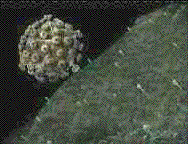
How a virus would normally look like.

The discovery of virus was by a Dutch Microbiologist and Botanist, Martinus Willem Beijerinck. It was just a normal day for Martinus, doing his filtration experiment in 1898 on tobacco mosaic disease. He was trying to prove that there is an agent smaller than a bacteria. Hence, he named that new pathogen, virus. The proper term for studying viruses is called Virology.

Through his findings, we can clearly understand that viruses are smaller than bacteria.

So what's in/on the virus? Well basically, what you can find in a virus are 3 important things.
  • DNA or RNA
  • Long molecules that contains genetic information
  • Protein coat that protects the genetics or an envelop of fats that surrounds the virus when outside a cell.
Without this 3 things, infecting a human is like injecting more blood into a human; nothing will happen.

As we all know, a virus requires a host in order for it to replicate itself. But we don't know what happens before, during or after this replication. As we go along, we will understand further what happens to the virus itself. We would also talked about examples of recent virus discoveries.

Till then, stay in tune.

Regards,
Faradilla
Karen
Khairul
Shobana
Thiviyan

Introduction

Hi and welcome to Microvirusey@blogspot.com.

In this blog, we will be talking about viruses and how it infects and affects homo sapiens like us. We hope that you would enjoy reading this blog as we will try our best not to bore you guys from reading it.

There will be words, pictures and also a definition of each difficult so as to allow you all to further understand the meaning!

Having an enjoyable time reading!